
Finding Industrial Buyers
why SaaS GTM breaks here, and what works instead

This is a standalone piece between POC Valley and the next series. Part 6 returns after May 27th.
If you’re new here, welcome! Part 1 introduced the POC Valley. Part 2 covered the qualification test before committing. Part 3 discussed tactics for navigating through. Part 4 examined the economics underneath.
“I never went to a tradeshow as a manufacturing engineer. It was online sources, community, and advertising.” — Aaron, Former Manufacturing Engineer, Tesla
Talk to enough manufacturing engineers and quality managers, and you start to notice something. None of them describes finding a vendor the way a SaaS buyer would.
Most early-stage industrial AI founders start with the SaaS playbook: BDRs booking meetings, cold email sequences, and LinkedIn outreach at volume. The standard playbook assumes a buyer who is online, low-risk, and autonomous. Industrial buyers are different, and three things kept coming up.
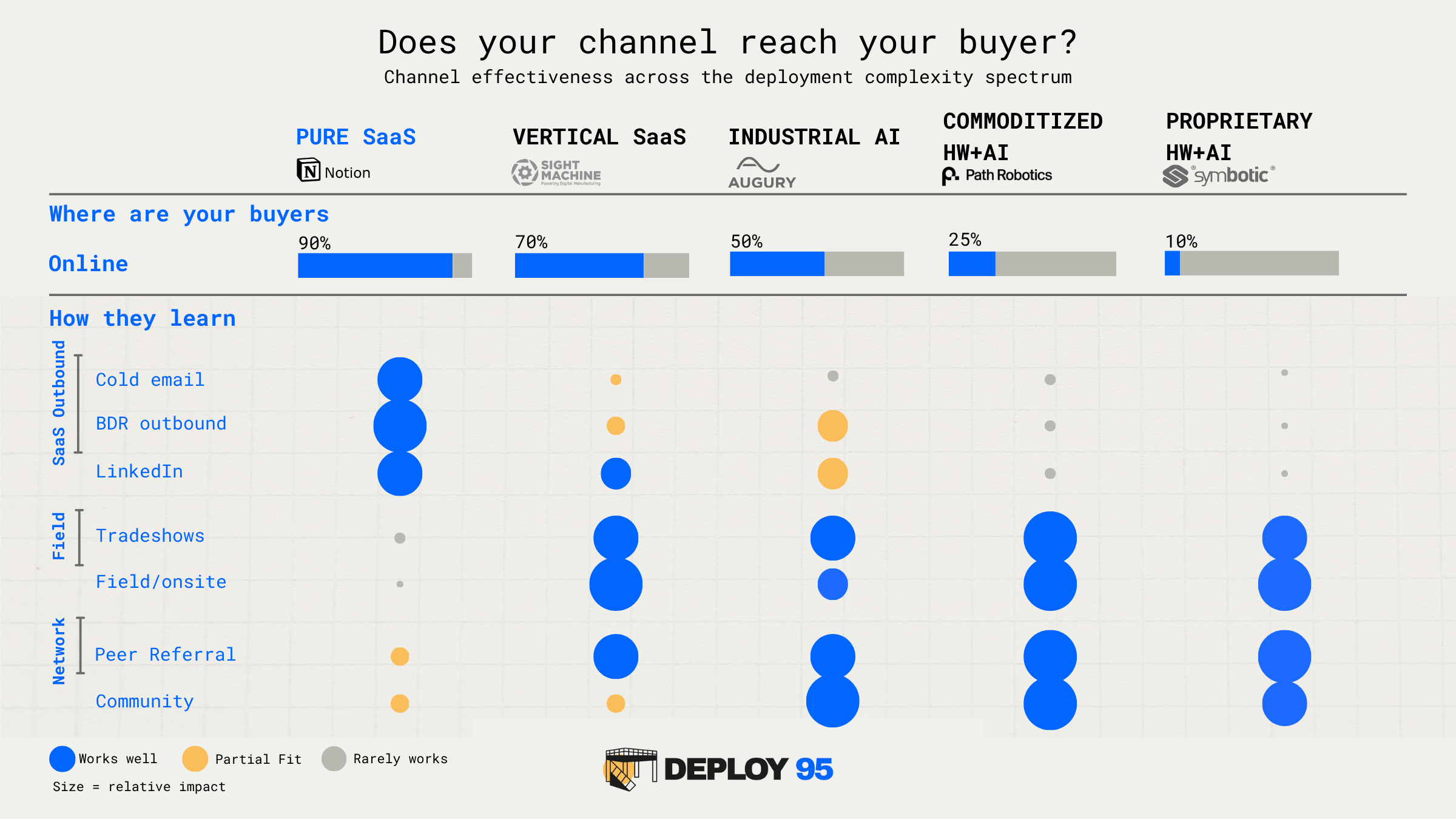
Why SaaS GTM Doesn’t Work Here
1. Your buyer isn’t at a desk
If you've spent time on a factory floor, you know what it costs to take a phone call in the middle of a shift. At a semiconductor fab, you're in full cleanroom gear. At a Gigafactory, you are in steel-toes, a hi-vis vest, goggles, and a safety hat. Unlocking your phone with gloved hands in a loud environment, stepping somewhere quiet to take a 15-minute call is almost impossible. The floor doesn't pause.
Early in my GTM journey, I would send one email, make a call, and follow up with two voicemails. I kept getting a variation of this:
“I am on the floor right now, will call you after 3 PM if this issue is resolved.” —TPM, Tier 1 Automotive
When these engineers are online, they're not where most founders are looking. They're on r/PLC at 11pm, deep in a thread about an ancient Allen-Bradley controller getting 309 upvotes from people who've been fighting the same machine for a decade. They're watching "Stuff Made Here" and texting the haircut robot video to a buddy. They have 26 LinkedIn connection requests collecting dust since January.
2. Your buyer is managing risk
Whether it’s a manufacturing engineer building a new line at a deep-tech startup, a controls engineer automating an end-of-line inspection process at a Tier 1 supplier, or a farmer deciding whether to put sensors on an irrigation system they’ve run the same way for twenty years, what they’re actually doing is managing risk. Your product is one more variable they’re trying to contain.
The first filter is proof of prior work.
“We were comparing two vendors. One had done similar processes before, the other had similar technology but not the same application. The experienced one was more expensive with a longer lead time. We decided no. We didn’t want to pay for their learning curve. They were bidding lower, but they’d run into obstacles that would push out the timeline and inflate the cost anyway.” — Alex, Former Lead Manufacturing Engineer, Commonwealth Fusion Systems
What surprised me was how much buyers will pay to avoid absorbing someone else’s learning curve. But proof of prior work is only the first gate. Even once a buyer decides they’re willing to engage, the bar shifts.
“When working with a new vendor, responsiveness and willingness to go the extra mile matter. I need a detailed spec and scope of work before I’m comfortable moving forward. I don’t like it when vendors give me a quote straight up for complex work.” — Glen Turley , former Tesla/Rivian now building next-gen contract manufacturing
The subtext of every reference call, every spec request, every slow reply that kills a deal: I need to know you’ve already made your mistakes somewhere else, and that you won’t make me run the process for you.
3. Your buyer has a specific problem
Your buyer has been stuck on a specific problem for weeks or months. Maybe it’s a welding contamination issue blocking a ten-unit-per-day production target. Maybe it’s a bin-picking cycle that can’t hit 26 seconds because of lighting conditions and budget constraints. He/she has exhausted the off-the-shelf options. When they finally go looking, they are searching for a specific solution.
“For some specific needs that existing solutions can’t solve well, I will just Google. I look for videos of their demonstrated deployment, and if it looks promising, I’ll engage and ask for a reference call.” — Pete, Manufacturing Engineer, Melling Engine Parts
The founder shows up with a roadmap. They talk about what the product will be able to do, the integrations coming next quarter, the vision for where the platform is headed. The buyer has already stopped listening.
“What can their thing do right now that meets my needs and solves a problem for me versus what are they promising for the future? Startups are fine, but don’t kid yourself about what they’ll be able to do in the future. Be comfortable with what they can offer right now.” — Alex, Former Lead Manufacturing Engineer, Commonwealth Fusion Systems
Where Buyers Actually Find Vendors
Across conversations with quality managers, manufacturing engineers, automation, plant managers, and OEM innovation leads, three channels showed up consistently.
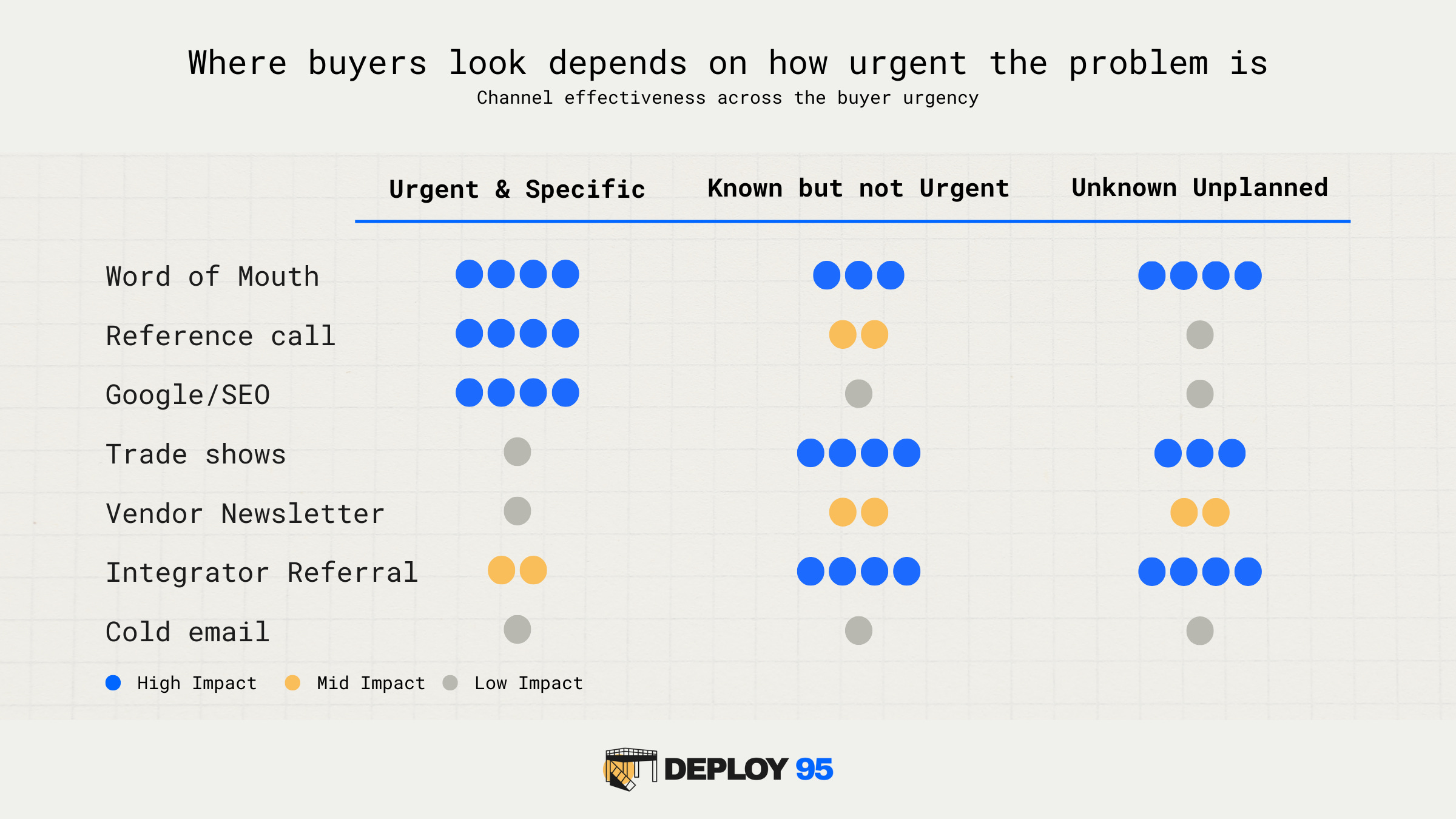
1. Word of mouth
Every conversation I had circled back to this.
“I lean on my previous experience and vendor base. Or speak to my network, particularly my GSM friends, to find vendors in the application I’m looking at.”
— Glen Turley, former Tesla/Rivian now building next-gen contract manufacturing
The referral network isn't random. The ex-Tesla engineer who knows which vendor ran the body shop line at Fremont isn't just sharing a contact; they're vouching for a specific technical fit in a specific context, which is the only kind of referral that actually moves a buyer. Your first customers make the next customer possible.
2. Google search
When a manufacturing engineer Googles, they already have a specific solution in mind and clarity on what the current solutions can’t solve. They go straight for evidence that you’ve solved this exact problem before.
“We did some straight-up Googling, especially early on when the team was small. We’d also look at pictures of what vendors were on previous projects and reach out to them because they have expertise in this area.” — Alex, Former Lead Manufacturing Engineer, Commonwealth Fusion Systems
A video of your system running on a real line, a forum thread where someone mentions your product unprompted, a reference in a trade press article, these carry more weight than anything in a cold email, because they exist independently of your sales motion. Google gets you on the shortlist. The reference call converts.
3. Trade shows and integrators
For problems that aren't urgent but are on the roadmap, discovery happens in a completely different register: trade shows, integrator relationships, vendor newsletters, internal innovation forums. This is slower, but it's also where reputation compounds.
“When it comes to tech discovery, I go to trade shows. Time to time I get emails from Fanuc with videos, or integrators, I check out what they’re up to and any new technologies. If the subject is relevant and there’s a video, I’ll check their references.” — Pete, Manufacturing Engineer, Melling Engine Parts
What Breaks Through
Knowing where buyers are isn’t enough. In every one of these channels, there’s already an incumbent.
“People tend to stick to vendors they know. They bring in vendors they’ve worked with at prior companies. It leads to a lack of innovation and sometimes real failures.” — Anna, Director of Quality, Former Tesla and 3M
Word of mouth favours whoever they worked with last. Search results favour whoever has more deployments. Trade shows favour whoever has been in the industry longest. The companies that broke through did it anyway.
Palantir — defence
Palantir sent engineers to live inside customer environments and proved the solution worked under real conditions before asking anyone to sign anything. You couldn’t email a defence program manager and expect a reply. You had to show up, start at the bottom, and stay long enough to matter.
“Take new tech and go to the field and do the demo. Lower-level commanders have a lot more purchasing authority than before, and they are at the user level. Go onto the military post, start at the bottom, and find where the rubber meets the road. Fifteen battalions of traction at the bottom leads to buy-in higher up.” — Alex Dolan , Former US Army Commander
Verdi — precision agriculture
Verdi found their ag buyers on TikTok. They posted a video, and farmers responded after hours, on their phones, scrolling through content about their actual lives. The #FarmTok hashtag has over 23 billion views. The farmer who won't open your cold email is watching irrigation troubleshooting content at 9 pm. That's the channel. It doesn't look like a channel because it doesn't appear in any GTM playbook written by someone who's never driven out to a farm.
Einsite — construction
Anirudh started building for construction in 2018, when almost nobody in Silicon Valley considered it a real category. He drove to sites as the most direct way to reach the site manager or project manager, who would never respond to a cold email.
“Driving down to sites was by no means the only way to meet them, but I found it to be the fastest and most direct way.” — Anirudh, early construction-tech founder now building in advanced manufacturing
UnitX — industrial vision
UnitX got into Tesla through an internal referral. A manager had heard about them through the engineering network, brought them in, and then the CEO showed up on the factory floor. The technology outperformed Cognex and Keyence on a specific application, detecting varying shades of grey that the incumbents simply couldn't handle. No SDR involved.
"UnitX was suggested internally… my manager had heard about this company from within Tesla or through a contact. And the literal CEO came to the line with us." — Aaron, Former Manufacturing Engineer, Tesla
Each company found their way in differently. The only common thread is that they figured out where their specific buyer actually was, and showed up there with something worth seeing.
What’s Next
Everything above assumes you have something to point to. A customer who can take the reference call. A line that’s running. A video of your system doing the thing it’s supposed to do.
If you’re earlier than that, the motion has to be different. Who do you talk to before you have references? How do you get in front of the right person when you don’t have an integrator relationship or trade show presence? How do you build credibility before the POC?
That’s what the next series is about. It starts after May 27th, after Part 6 of POC Valley.
If you’re building in this space, I’d love to know: what’s the question you’re stuck on? That’ll shape what I write next.
About Deploy 95
Hi! I’m Trista, a former founder, early GTM at UnitX, now a GTM strategist for technical founders deploying into legacy industries. Special thanks to Aaron, Alex, Alex Dolan , Anna, Anirudh, Glen Turley, Pete, Shaun, Kevin, and Kit, who shaped this analysis.
If you’re building in this space, or buying, or stuck somewhere in between, I’d love to hear from you.
Glossary
BDR — Business Development Representative. Entry-level sales role focused on outbound prospecting and booking meetings.
SDR — Sales Development Representative. Often used interchangeably with BDR; focused on qualifying inbound or outbound leads before passing to a closer.
POC — Proof of Concept. A limited deployment to demonstrate that a technology works in a specific customer environment before a full purchase commitment.
GTM — Go-to-market. The strategy and tactics a company uses to reach customers and generate revenue.
Cognex / Keyence — Incumbent machine vision companies. The established vendors that most manufacturing buyers default to for inspection and quality applications.
Allen-Bradley — A Rockwell Automation brand. One of the most common legacy PLC (programmable logic controller) systems in North American manufacturing.
Integrator — A third-party company that implements and connects automation systems for manufacturers. Often the trusted relationship that brings in new vendors.
Tier 1 supplier — A company that supplies components directly to an OEM (original equipment manufacturer), like an automaker. High volume, tight tolerances, low margin for error.
OEM — Original Equipment Manufacturer. The company whose name goes on the final product (e.g., Tesla, Ford, Apple).
r/PLC — A subreddit where controls and automation engineers discuss programmable logic controllers, troubleshooting, and industrial automation.
#FarmTok — The farming community on TikTok, where agricultural content creators share equipment reviews, troubleshooting, and day-to-day farm life.
The persona articulated here is unlikely to be your actual buyer, but they certainly influence the buying decision!
This was spot on. Great write up! And a good call out that newer companies have a higher burden of proof