
Navigating the POC Valley
Part 3: the judgment call on when to push, wait, or walk away

This is Part 3 of a six-part series on selling technology with a physical footprint into legacy industries: manufacturing, industrial, and operationally complex enterprises.
Part 1 introduced the landscape: four organizational gaps that kill deals before they close. Part 2 was about prevention: how to qualify and scout the terrain before committing resources.
This part is about navigation: you’re already in the valley, and now you need to decide which deals deserve your next month of effort. The instinct is to push everything forward. But sometimes, knowing which deals to stop pushing gets you further than trying to close them all.
How You Got Here
Founders tend to believe every deal should get through. So when one stalls, the natural question is: why are we stuck? What that often really means is: why aren’t we pushing harder? Any explanation starts to sound like an excuse.
But sometimes the lack of progress has nothing to do with the effort your team puts in. Ask the question differently, and a better path forward emerges.
Did we get stuck because we missed something early, or because we ran into something we couldn't have seen until we were inside?
The first points to a gap in the qualification process. Part 2 talked about how to spot the signals that a deal isn't ready to move. The second is a different problem. You can't prevent a blocker you couldn't see coming. And those tend to fall into two buckets:
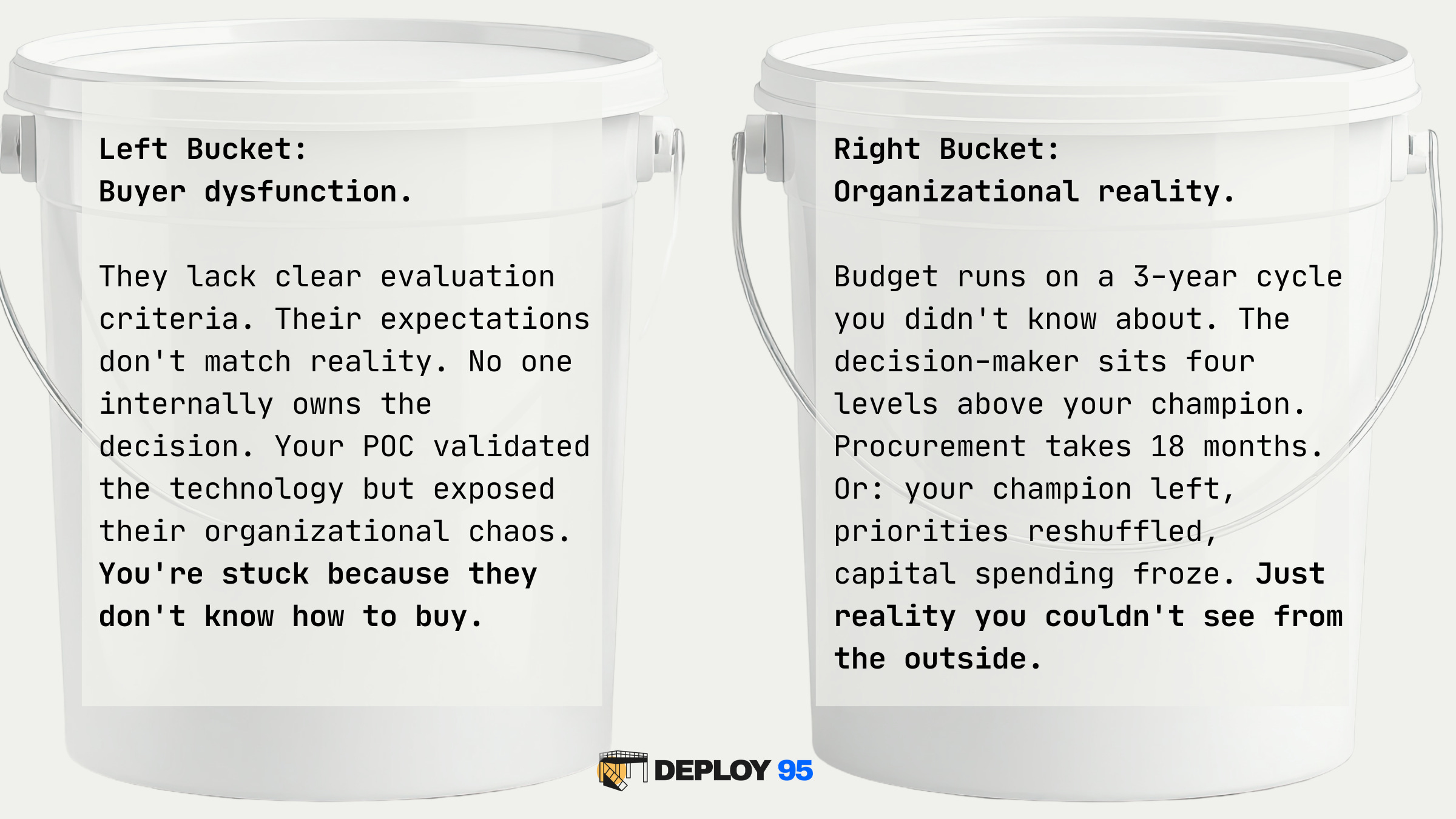
Now you're inside the organization. The question becomes: can you change those conditions, or is it time to cut your losses?
For founders used to pushing through, walking away can feel counterintuitive, especially when you're under pressure to show growth in booked value. But a stuck deal is expensive and slows everything down. It's like hauling a case of champagne up Everest because you planned to celebrate at the summit. At some point, the weight isn't worth the dream.
The Math That Makes This Expensive
Let’s put numbers to this.
In B2B SaaS, sales cycles scale predictably with deal size, roughly one month for every $10K in ACV. Industrial automation, however, doesn’t follow that logic. Manufacturing has some of the longest sales cycles in B2B, often 12 to 18 months or more. The reasons stack up: capital expenditure approvals, multi-stakeholder procurement, and integration complexity that touches production systems no one wants to break.
The graph below shows what this looks like side by side.
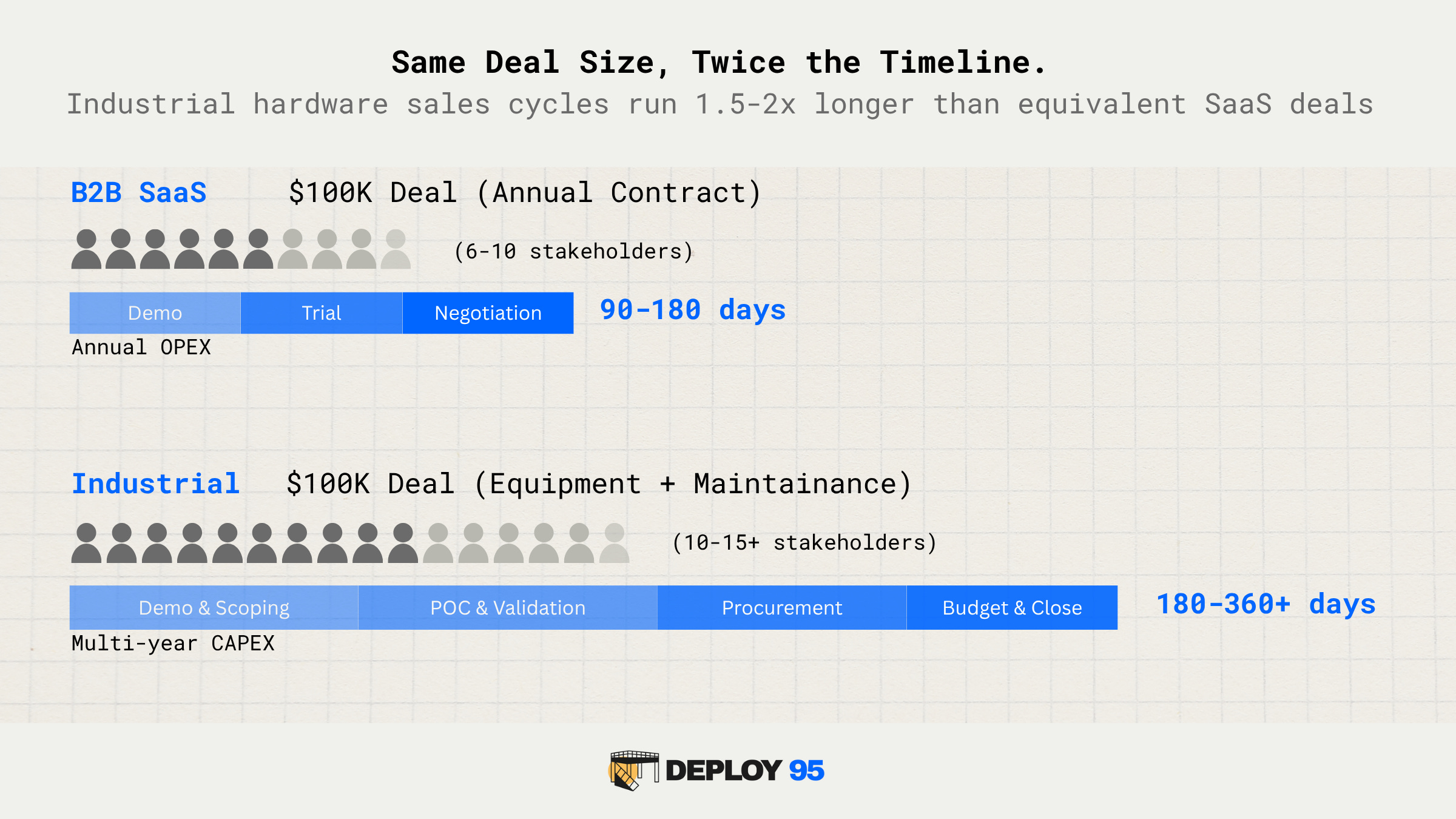
What the graphic doesn’t show is the cost multiplier.
A $100K SaaS deal might cost you $10–15K to close. That covers sales rep time, a solutions engineer for demos, and some legal review.
The cost of a $100K industrial deal? Application engineers spend weeks on scoping and integration. POC and validation may require custom hardware builds and on-site pilots, which include travel, installation, and equipment you’re floating until the deal closes. By the time you reach procurement, you've likely invested $40–60K or more.
That's 4–6x the cost for the same contract value. And that's assuming it closes.
“If we fail, it’s going to fail on our site before we do any shipping and installing... It’s a lot cheaper to fail at home than it is to fail abroad.” — Former Sales Operations Lead, GrayMatter Robotics
Every week a deal stays stuck, you’re burning engineering hours, carrying hardware costs, and pulling resources from opportunities that might actually convert. Unlike SaaS, a failed industrial POC doesn’t just cost resources. It costs credibility in a market where everyone knows everyone.
This is why getting stuck is so dangerous.
Story 1: The Intern Problem
January. A head of automation engineering at a medical device company liked what he saw. But he was honest: “I want to do this. I just don’t have the bandwidth until Q3.”
Months passed. Then a summer intern arrived: his nephew, tasked with evaluating and installing the equipment. Progress, finally. But interns need ramp time. Competing priorities kept pushing the project down the list.
Nine months after that first conversation, the deal closed.
The lesson wasn’t patience for its own sake. It was reading the signal: he wanted to buy. He just couldn’t move faster than his organization allowed.
Blocker: Internal resource constraints
Verdict: Nurture. Match their pace. Stay warm. Don’t push a timeline they can’t meet.
Story 2: The Pet Project Trap
A former production project manager described a pattern that repeats across large manufacturers:
“Our organization gets POCs stalled all the time. Smart factory initiatives fizzle out, then someone new tries to revive them. They get excited, dig in, realize it requires cross-functional alignment, discover that’s hard, and it fizzles out again.”
This is the pet project trap. A mid-level engineer launches a pilot as a side project. The POC works. But scaling requires sign offs from operations, IT, procurement, and finance; alignment they never had the authority to build.
The technology worked. The organizational commitment didn’t.
Blocker: Champion without power
Verdict: Fold. A project that lives on one person’s enthusiasm dies when enthusiasm isn’t enough.
Story 3: The Logo Game
Technical tests at a major EV battery manufacturer went well. Ground-level credibility was strong. But the deal was stuck.
What didn’t work: more follow-ups, more documentation, extending the pilot.
What worked: we stopped pushing through our existing contact and leveraged a different angle. The solution was already deployed at their downstream customers—and leadership didn't know. A former CTO from the company, brought on as an advisor, knew where power actually sat. He made the introduction directly.
Eighteen months later: signed contract.
Blocker: Access to decision-makers
Verdict: Fight smarter. We didn’t push through our champion. We went around him.
This worked for us. Whether the advisor route works for you depends on whether you can find someone with real access, not just a name on an org chart. That’s harder than it sounds.
Each of these stories ended differently. Here's how to think about which path fits your situation.
What Cards You Can Play When You’re Stuck
Some blockers are movable. Some need time. Some are permanent.
“One of the things I learned, and had to learn the hard way, is that POCs have to be time-bound... The worst outcome is no decision: they just keep using it and never tell you." — Former VP Sales, Armory
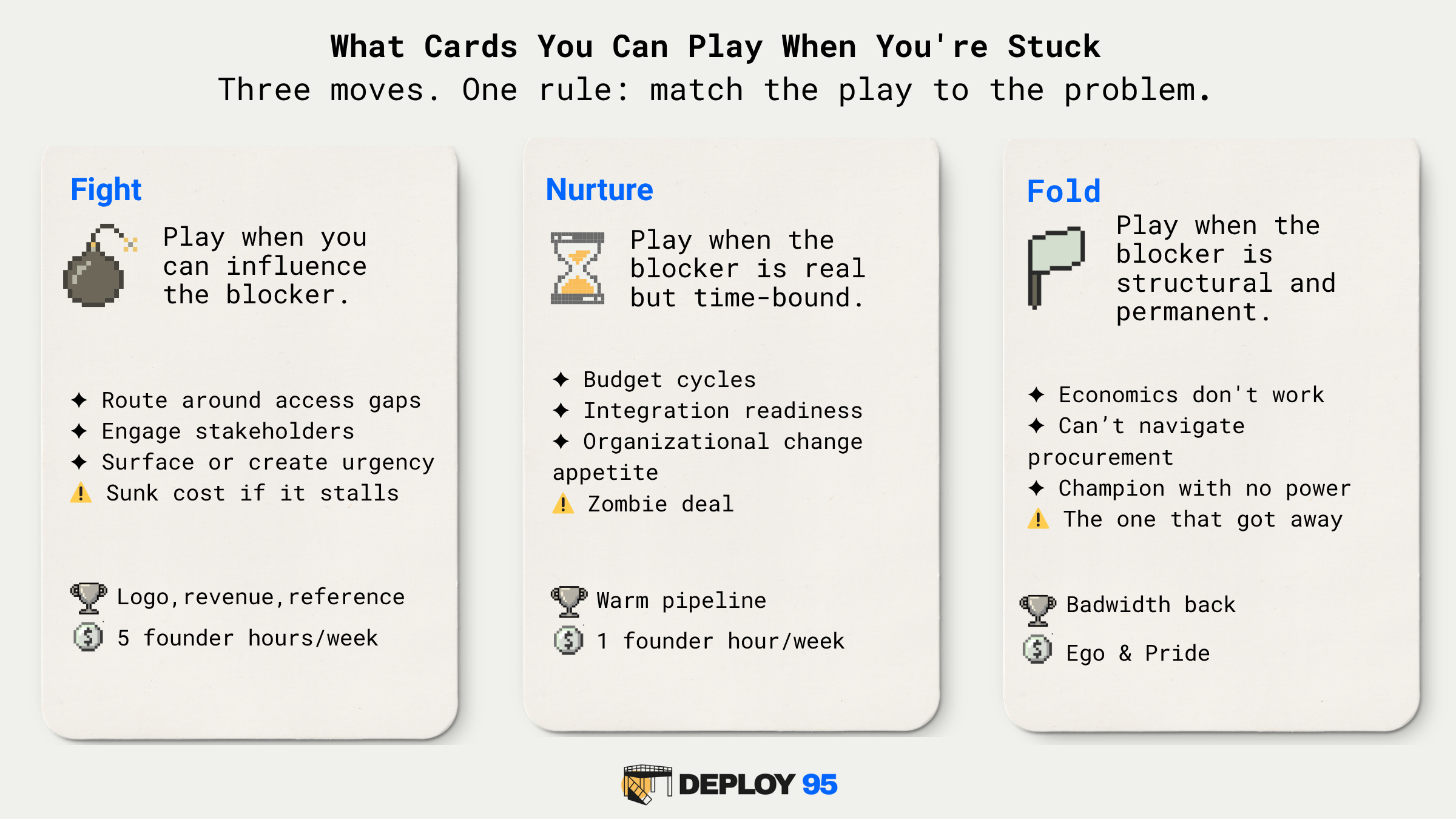
Before you decide what to do, ask yourself: What kind of blocker am I facing? Your answer determines which card to play.
Play the Fight card when the blockers are things you can influence: access gaps you can route around, stakeholders you can engage, urgency you can surface or create. But fighting is expensive. It costs founder hours you can't get back. Reserve it for accounts where you have real leverage and the strategic value justifies burning the cycles.
Play the Nurture card when the blockers are real but time-bound: budget cycles, integration readiness, organizational change appetite. Stay visible, stay valuable, stop burning resources on conversion attempts that can't succeed yet. Stay in the game for when the window opens.
Play the Fold card when the blockers are structural and permanent: economics that don't work, procurement systems you can't navigate, a champion with no path to power. Exit gracefully. Preserve the relationship. Redeploy your resources to deals where the conditions for success actually exist.
Losing a deal early that would have drained your next six months isn’t failure. It’s a gift. It frees bandwidth for deals that could actually close.
Of course, knowing when to fight, nurture, or fold is easier said than done.
Reading the Terrain
Industrial AI sales cycles don’t run on SaaS timelines. They stretch across seasons, and conditions shift along the way. What looked like a clear path in Q1 can become impassable by Q3. You can't qualify once and assume the answer stays true. You have to keep evaluating.
The cards we’ve outlined (Fight, Nurture, Fold) work. But they’re founder cards. Playing them well requires judgment, relationships, and pattern recognition that live in one person’s head. That’s fine when you’re closing your first ten deals. It’s a ceiling when you’re trying to close your next hundred.
Heroics win early deals. Systems win markets. As you scale, the playbook has to shift from personal reads to team coordination. And underneath all of it, one question should stay constant: Do the conditions exist for them to buy if we succeed?
What Part 1,2,and 3 Have Given You
Part 1 explained why the POC valley exists. Industrial deals carry structural traps that software sales don’t. These aren’t objections you overcome with better pitching. They’re terrain.
Part 2 teaches you how to scout that terrain before committing. To qualify not just interest, but whether the conditions exist for a deal to actually close.
Part 3 is what happens when you're already inside and something shifts. Now the question is whether you're facing a pass that will eventually open, or a dead end that won't.
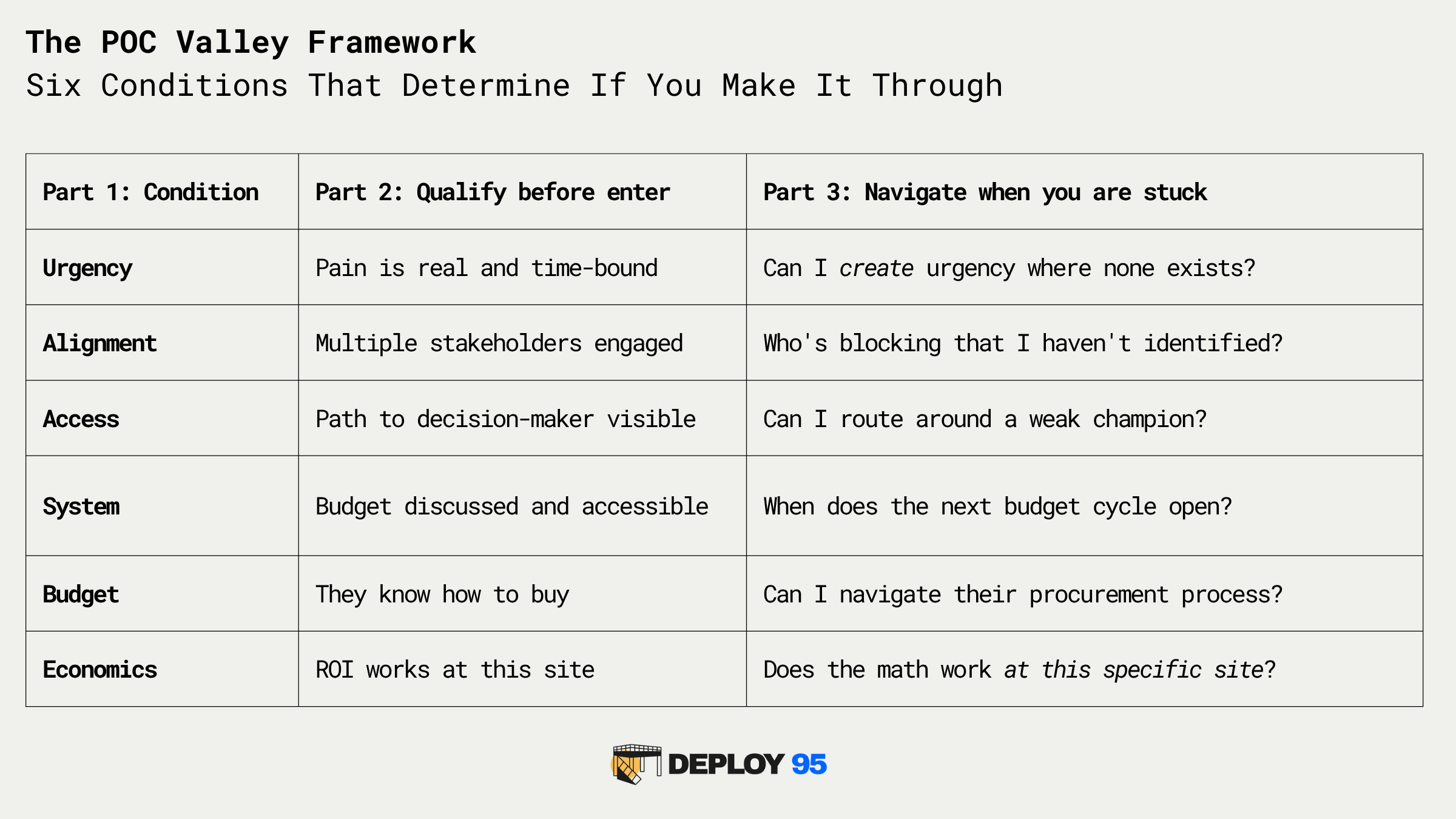
The instinct is to believe persistence and will can get you through. But we underestimate the importance of discernment: building the judgment to know which stuck deals deserve resources, and the discipline to redeploy from the ones that don’t.
You optimize for booked value today while ignoring the operational debt you’re accumulating. The deals you force through now become the nightmares you inherit at Series B. We often don't learn about these subtler traps until it's too late.
In Part 4, we’ll unpack this: the mismatch between what VCs reward and what actually builds a sustainable business, and how to structure deals so booked value today doesn’t become operational debt tomorrow.
About this series
Hi! I’m Trista, a former founder, early GTM at UnitX, now a GTM strategist for technical founders deploying into legacy industries.
This series grew out of conversations with founders, operators, and enterprise leaders working at the intersection of hardware, automation, and manufacturing over the past 18 months. This series wouldn’t exist without those who shared their experiences often candidly, sometimes painfully. Special thanks to Justin, Steve, Anthony, Kit, who allowed me to quote their insights that shaped this analysis.
If you’re building in this space, or buying, or stuck somewhere in between, I’d love to hear from you.
Glossary
ACV (Annual Contract Value) — The annualized revenue from a contract. Used to normalize deal sizes for comparison.
Booked Value — Revenue that’s been contracted or committed on paper. The primary metric investors use to measure early-stage progress—but it doesn’t account for the operational costs of actually delivering on those contracts.
Champion — The internal advocate at a prospect company who believes in your solution and pushes for adoption. A champion without organizational power or cross-functional influence is a liability, not an asset.
Churn — Customers who cancel or don’t renew. In hardware businesses, churn is especially painful because it triggers retrieval, refurbishment, and redeployment costs on top of lost revenue.
Hardware-as-a-Service (HaaS) — A business model where customers pay recurring fees for hardware access rather than purchasing equipment outright. Reduces barriers to adoption but creates operational complexity when customers churn.
POC (Proof of Concept) — A limited deployment designed to validate that a solution works in a customer’s environment. In industrial contexts, POCs are expensive, time-consuming, and carry reputational risk if they fail.
Procurement — The formal purchasing process at enterprise companies, typically involving legal, finance, IT, and operations sign-offs. Many technically successful POCs die because no one mapped the procurement path before starting.
Sales Cycle — The time from first contact to signed contract. Industrial automation sales cycles are significantly longer than SaaS—often 12-18+ months—due to capital expenditure requirements and multi-stakeholder approval processes.
SaaS (Software as a Service)— Software delivered over the internet on a subscription basis, rather than installed on-premise. Customers pay monthly or annually for access. Examples: Salesforce, Slack, HubSpot.
Stakeholder — Anyone who influences or must approve a purchase decision. In manufacturing, stakeholders typically span operations, engineering, IT, finance, and procurement—each with different priorities and concerns.
Great insight often missed when planning sales!
how important is it that you have a champion that "gets" your tech at a deep level? I've worked deals before where the champ sold themselves without me having to push or persuade, but their product understanding was shallow. It didn't seem like an issue until the deal hit some resistance and they were ineffective at selling internally.