
Quality Follows Risk, Not the Org Chart
A Framework for Finding Your Buyer in Manufacturing

This newsletter covers go-to-market strategy for founders selling AI and hardware into manufacturing. If that’s you, or you’re investing in this space, you’re in the right place.
This is the second post in a series on the manufacturing tech sales journey. This one maps the quality buyer.
Quality Follows Risk, Not the Org Chart
You reach out to a VP Quality, but can’t move forward without clear use cases. You reach out to Quality Managers, 2% reply with “this isn’t relevant.” You try the Plant Manager, thinking maybe quality isn’t the right door. Sometimes it works. Sometimes it doesn’t. Each company feels like starting over.
There's no consistent path because quality isn't a department. It's a risk-allocation function, and risk differs by company, so quality does too.
“When things go poorly, quality is brought in either to blame or to fix.” — Anna Boyd, Founder, Next Rev Solutions, ex Redwood Materials, Tesla, 3M
I spent two months talking to quality, engineering, and operations leaders across Tesla, Rivian, Redwood Materials, Ford, Kraft Heinz, PepsiCo, Blue Origin, and Tier 1 and Tier 2 suppliers. Every one of them described a different org. All of them were describing the same three risks.
Three Risks Quality Prevents
Quality Management System (QMS) reduces Compliance Risk
QMS protects the company's right to operate. It guards against failed audits, lost certifications, and regulatory action. A single compliance gap can trigger fines, customer disqualification, or a plant shutdown.
In February 2022, Abbott shut down its Sturgis, Michigan plant after an FDA inspection. The country ran out of baby formula for months, all due to a quality system problem!
Supplier Quality Reduces Supplier Risk
Supplier Quality protects against defective material entering production, mixing with good stock, causing scrap, rework, and unplanned downtime. A single bad batch from a single supplier can halt an entire plant. The cost compounds: the lost production, the downstream rework, the customer impact.
Takata's airbag inflators became the largest automotive recall in U.S. history, roughly 67 million inflators across 19 automakers. None of those automakers made the defective part, but all of them paid for it.
Customer Quality Reduces Customer Risk
Customer Quality protects the relationship. An escape reaches the field. A warranty claim triggers an investigation. A recall makes the news. What you lose is trust, the contract, and years of revenue that walking out the door.
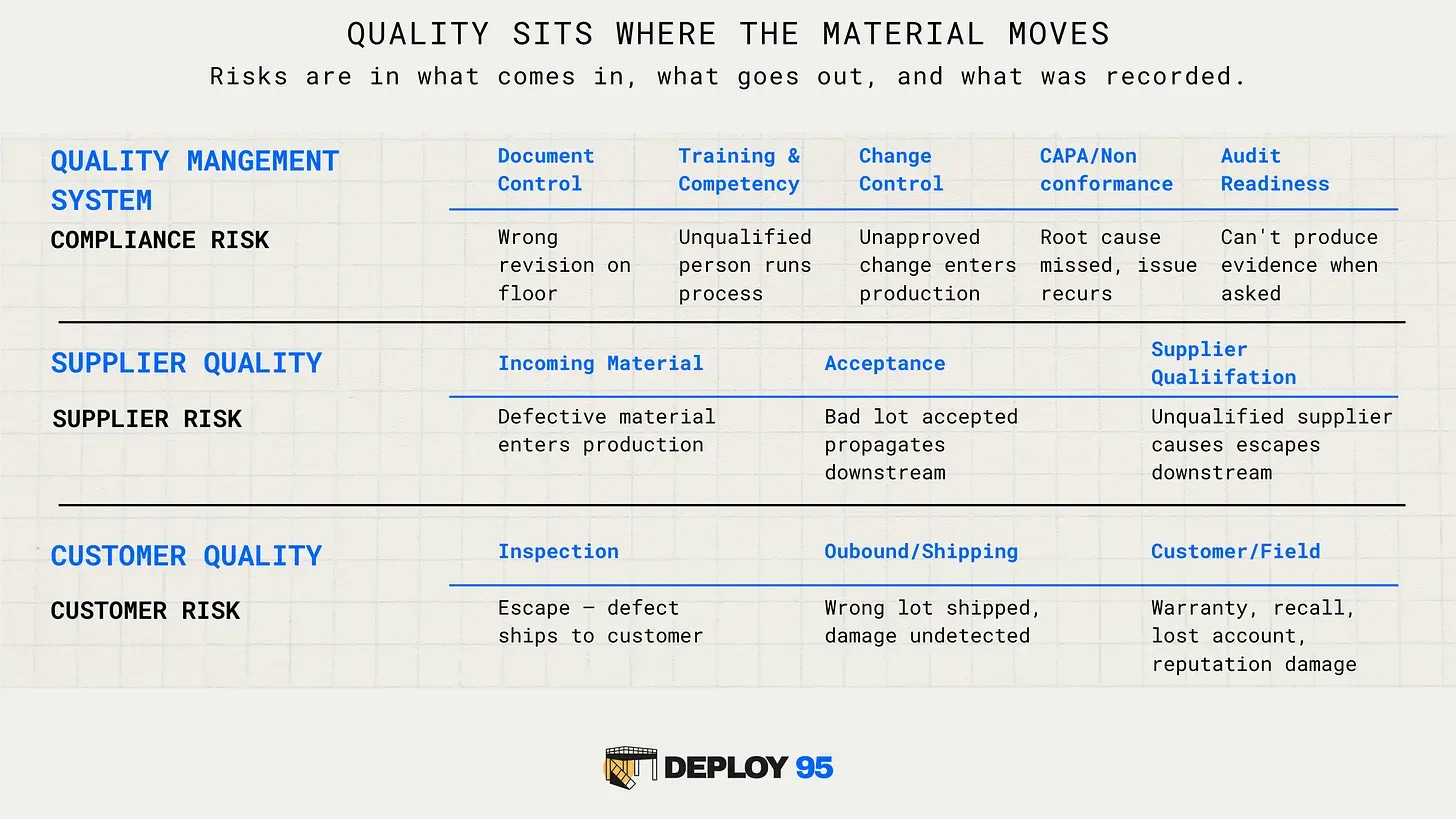
Every company carries all three risks. But not every company treats them equally.
Which Risk Dominates Determines Where Quality Gets Staffed
It comes down to how expensive each failure is and how expensive prevention is when the failure isn’t likely.
Compliance Risk
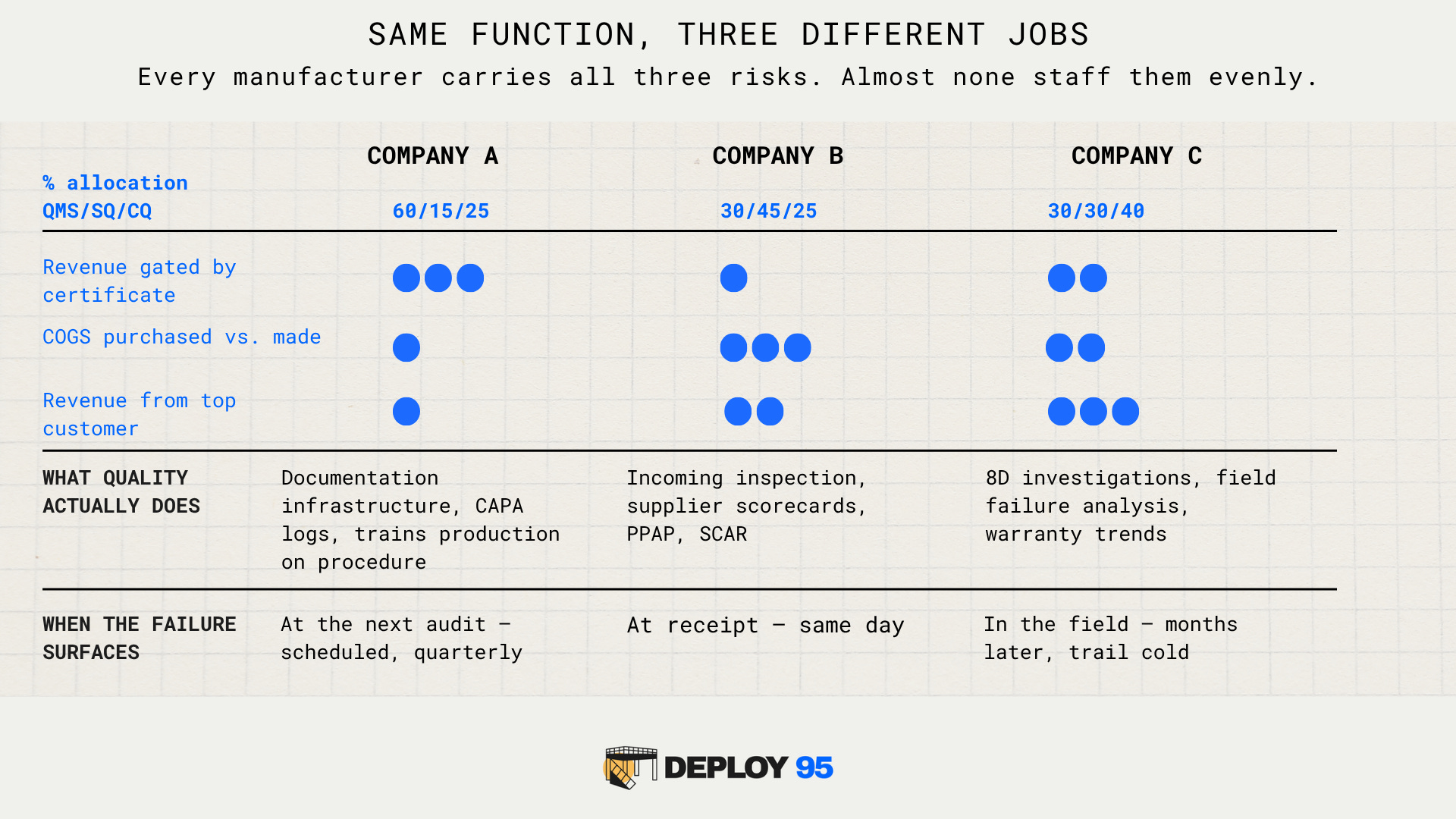
What share of revenue is gated by a certificate? If you can’t bid without AS9100 or IATF 16949, the certificate is the business. If it’s a nice-to-have, QMS is overhead.
“The aerospace industry is highly regulated, and it’s really hard to innovate unless you just don’t give a damn about the law.” — Former Controls Engineer, Blue Origin
Supplier Risk
What share of COGS is somebody else's process? If you are vertically integrated, risk is low. If >50% is supplier parts, it’s high. Risk also multiplies by supplier geography and tiers.
Eighty percent of a car is supplier parts. The supplier quality engineer’s job is to make sure those parts are okay before they become the car. - Stefania, Supplier Quality, ex Stellantis
Customer Risk
What share of revenue is your top customer? One customer at 40% means one escape is an existential. Fragmented base means it's a warranty line item.
They’re paying the price of a car for a single piece of pure silver. We might make a hundred that day, but they care about theirs. A little scratch? They’re upset — Raven, Quality Engineer, Specialty Materials for Semiconductor Manufacturing
Detecion lag matters
A compliance failure surfaces at the next audit scheduled, months out. A supplier failure surfaces at receipt, same day. A customer failure surfaces in the field? Six months later, through a complaint, with the root cause cold.
The longer the lag, the more people it takes to investigate, and the more of the quality org gets pulled downstream. Staffing follows detection lag as much as risk size.
Quality Competes for Someone Else’s Budget
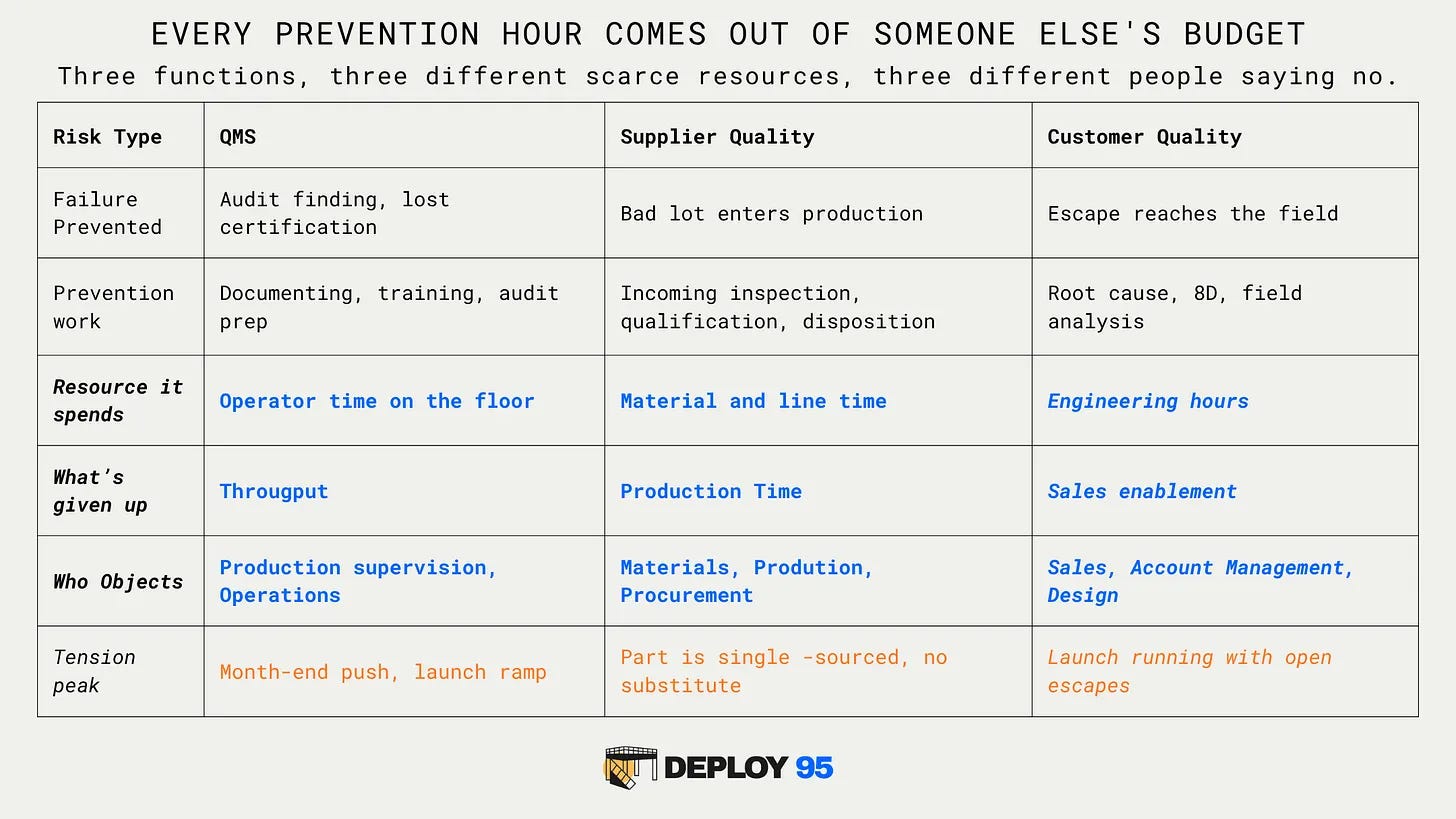
Quality has authority without resources. A quality manager can stop a shipment, reject a lot, or hold a release, but they can’t move schedule, add headcount, or call the customer without spending someone else’s budget.
II can say here is the requirement, thou shalt follow it. But that doesn’t help people know why they need to do it. — Anna Boyd, Founder, Next Rev Solutions
QMS spends operator time. Production objects. Tension peaks at month-end and during a launch ramp, when the same operators are the constraint on both sides.
Supplier quality spends material and line time. A marginal lot at receiving constrains on the production timeline. Procurement objects: sort it, use it, keep moving. Tension peaks when the part is single-sourced.
Customer quality spends engineering hours. A real 8D takes weeks of the same engineers everyone wants. Sales objects because a customer is waiting on closure; Design objects because the new program is slipping. Tension peaks when old and new products compete for the same six people.
Most of the time one side is clearly right and the argument is short. The hard version is when neither is wrong.
How to Find Your Buyer in Quality
The instinct is to search by title. But title doesn’t map to function in quality, risk does.
Step 1: Name the Failure You Stop
Your product does something. The question is what failure stops when it runs. The answer changes depending on where it sits.
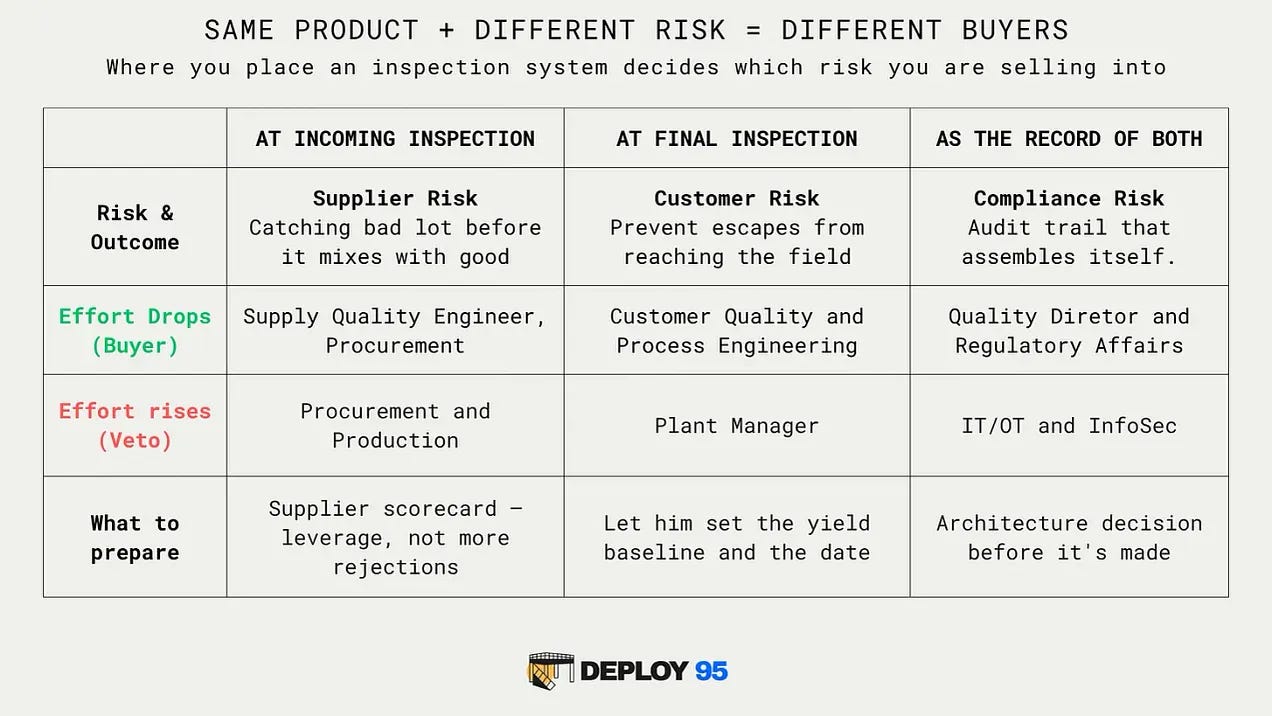
One inspection system, three answers:
At incoming inspection → supplier risk. A bad lot gets caught before it mixes with good stock.
At final inspection → customer risk. An escape stops reaching the field.
As the record of both → compliance risk. The audit trail assembles itself.
Same technology. Three risks. Lead with one.
Step 2: Find the Owner and the Person Who Pushes Back
Your solution is moving the risk around within an organization. Somebody’s week gets lighter; that’s your buyer. Somebody else’s gets heavier; that’s your veto, and they’re usually not in the room.
I would never go to quality managers. Find the quality director. The quality manager doesn’t have enough power. — Keith, Continuous Improvement, Fortune 500 Manufacturer
The second half of the playbook, who vetoes you and what to bring them, is for subscribers only. Subscribe for free to access the playbook.
What This Means for Your Next Outreach
Quality is really the first thing in manufacturing. That's something that was lost. - Tolison, Owner and Operator, Hub Pattern Corporation
Go back to the outreach that wasn’t working.
The VP of Quality who wouldn’t move without a use case was asking which risk you reduce. The Quality Manager who replied “this isn’t relevant” was telling you that you’d pitched the wrong risk, and for that plant, they were right. The Plant Manager who took the meeting owned the trade-off that week.
Before your next email: name the dominant risk, find who’s paying for it, and write to the tension they’re already in.
This is a map drawn from a dozen conversations, not a law. If you’ve sold into a quality org that didn’t work this way, I’d genuinely like to know; that’s the version of this I don’t have yet.
About Deploy 95
Only 5% of industrial AI pilots convert to full deployment. This newsletter is about that gap: what happens between your model and the factory floor.
Hi! I’m Trista, grew up in manufacturing, built GTM at UnitX, now helping technical founders close the gap between traction and deployment.
New here? Start with the POC Valley Series.
Building in this space? Let’s connect on LinkedIn.
Glossary
QMS (Quality Management System) — The documented processes, procedures, and records that demonstrate a company meets regulatory and customer requirements. Protects the right to operate.
SQE (Supplier Quality Engineer) — The person responsible for ensuring incoming materials meet spec. Catches supplier problems before they reach the line.
NCR (Non-Conformance Report) — A formal record that something didn’t meet spec. Triggers investigation, disposition, and corrective action.
8D — An eight-step problem-solving methodology used to investigate root cause of defects, typically required by automotive customers. Takes weeks when done properly.
Escape — A defect that passes all internal checks and reaches the customer. The failure that customer quality exists to prevent.
AS9100 — Quality management standard for aerospace. Required to bid on most aerospace contracts.
IATF 16949 — Quality management standard for automotive. Required by most OEMs to be a qualified supplier.
Disposition — The decision on what to do with non-conforming material: use as-is, rework, scrap, or return to supplier.
Containment — Immediate action to isolate suspect material and prevent it from moving forward in production or reaching customers.
COGS (Cost of Goods Sold) — Direct costs of producing goods. Relevant here because supplier quality risk scales with how much of COGS is someone else’s process.
I used AI to help draft and structure. The same way every writer uses an editor, a co-author, or a whiteboard. The thinking, the sources, the framework, and the floor-level intelligence are 100% my original work.