
Is Industrial AI GTM Built Different?
Zero-to-one GTM Part 1: What 40+ vision AI companies reveal

This newsletter covers go-to-market strategy for founders selling AI and hardware into manufacturing and industrial environments. If that’s you, or you’re investing in this space, you’re in the right place.
This is Part 1 the Zero-to-one GTM Series. In this series, we will cover why industrial AI GTM breaks conventional wisdom, the mistakes founders make early, and a framework for deployment-led growth.
Studying 40+ vision AI companies
Most of the GTM advice available to industrial AI founders comes from SaaS, where the product can prove itself in a demo or a free trial. I wanted to know: does that advice actually hold in industrial AI, where the product only proves itself after it’s installed on a factory floor?
To find out, I compiled data on 40+ computer vision companies, including startups founded between 2000 and 2026, and established players like Cognex, Keyence, and Matrox. I organized them along a spectrum from pure software to integrated hardware, separated into five tiers based on how much of the product’s performance depends on the customer’s environment versus the product itself.
I looked at three things: their marketing claims, their GTM motions, and their vertical concentration. Three questions guided the analysis:
Do the trends favour pipeline-driven growth or deployment-driven growth?
Did any creative outbound approach actually work at the deployment layer?
What do the companies that scaled have in common?
1: Proof Only Exists After Deployment
As products get more embedded in the customer's physical environment, what counts as "proof" shifts. At the software end, a benchmark or demo is enough. At the hardware end, only a deployment outcome counts.
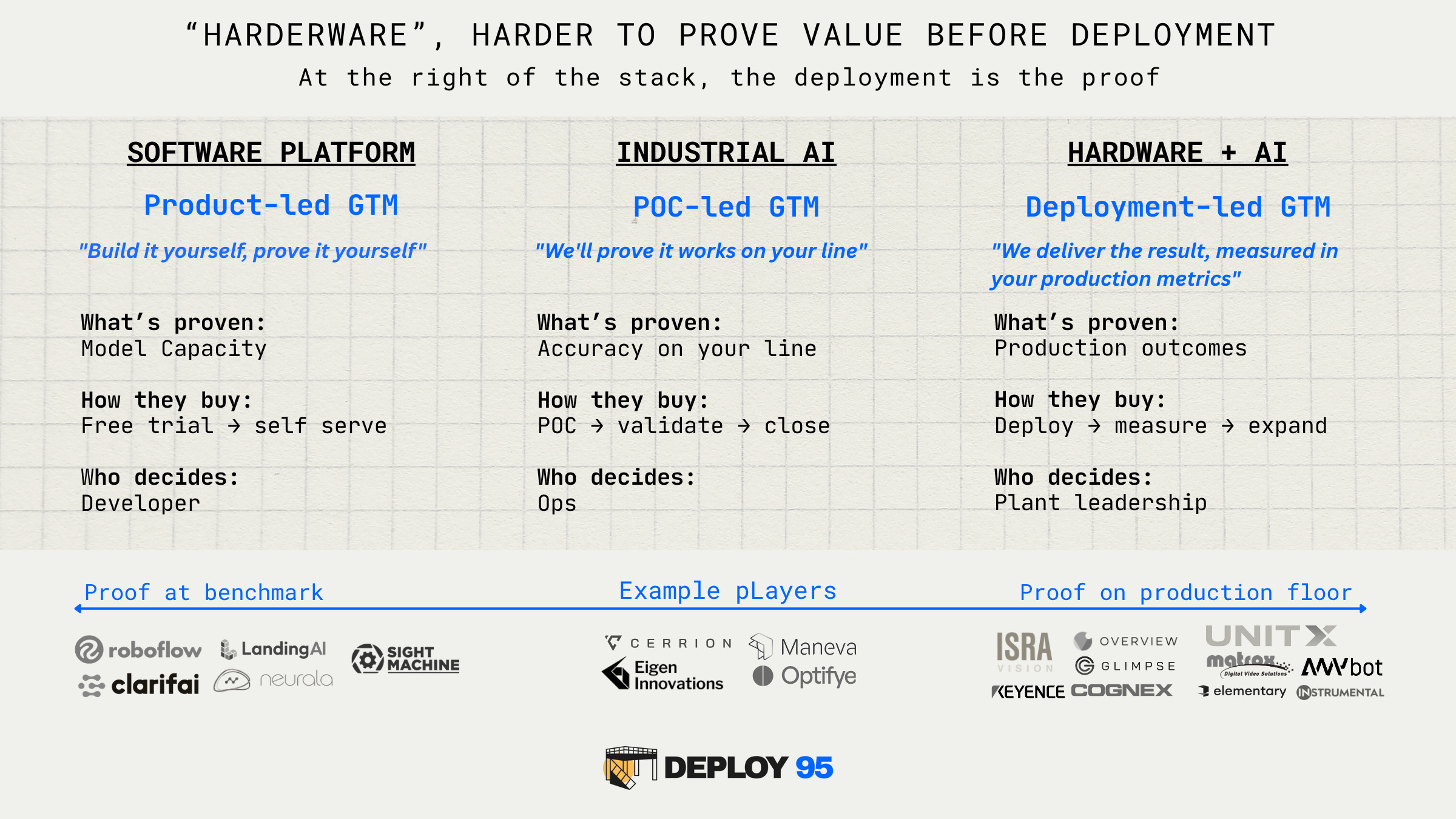
Platforms like Roboflow and Clarifai follow the textbook PLG playbook: freemium tiers, developer communities, content marketing. Their customers are developers. The product proves itself in a browser.
As you move toward integrated hardware, the GTM motion flips. A demo alone cannot close the deal, because performance depends on the customer’s specific environment. They need to see it working on their line.
Because every environment is different
The reason customers will not sign a deployment deal based on a demo is that the cost of getting it wrong is high. A SaaS tool that disappoints gets cancelled. A hardware system bolted onto a production line is expensive to unwind. So customers insist on testing in their own environment.
How big of a variation could this be? Take porosity inspection: detecting voids in metal castings. You might expect that a model trained on porosity should work across castings. But the same model, same defect type, produces different results depending on surface condition, part geometry, and factory environment.
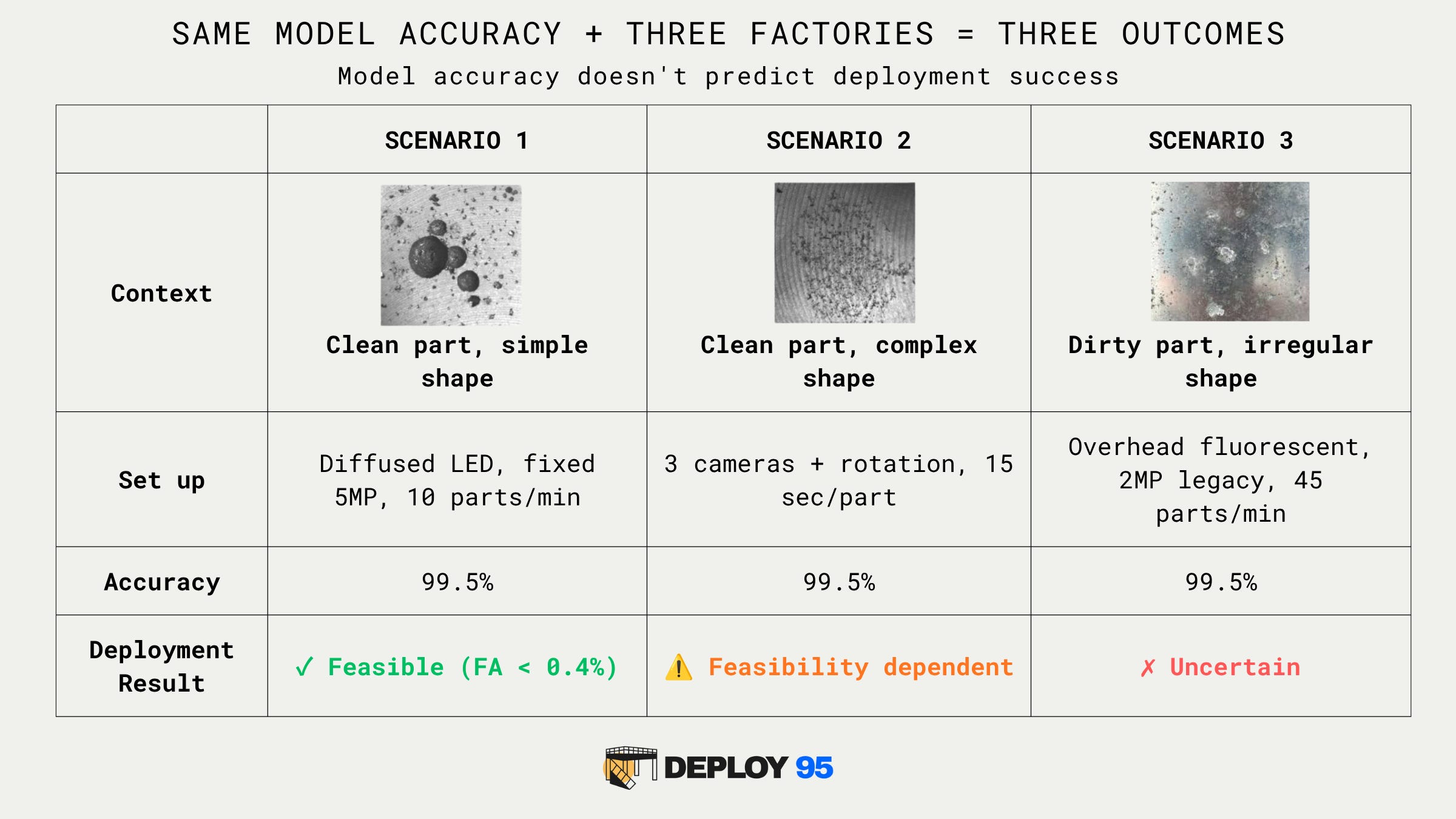
A model that works on a flat, clean surface is not ready for an oily shop floor or a part that needs robotic handling. No simulation captures this variation. When you are starting from zero, the only way to build customer confidence is to test in their environment.
2: Learning Only Compounds with Focus
If deployment is the proof, should you deploy as broadly as possible to build scale? The answer from the data: the more hardware-embedded you are, the narrower you usually go.
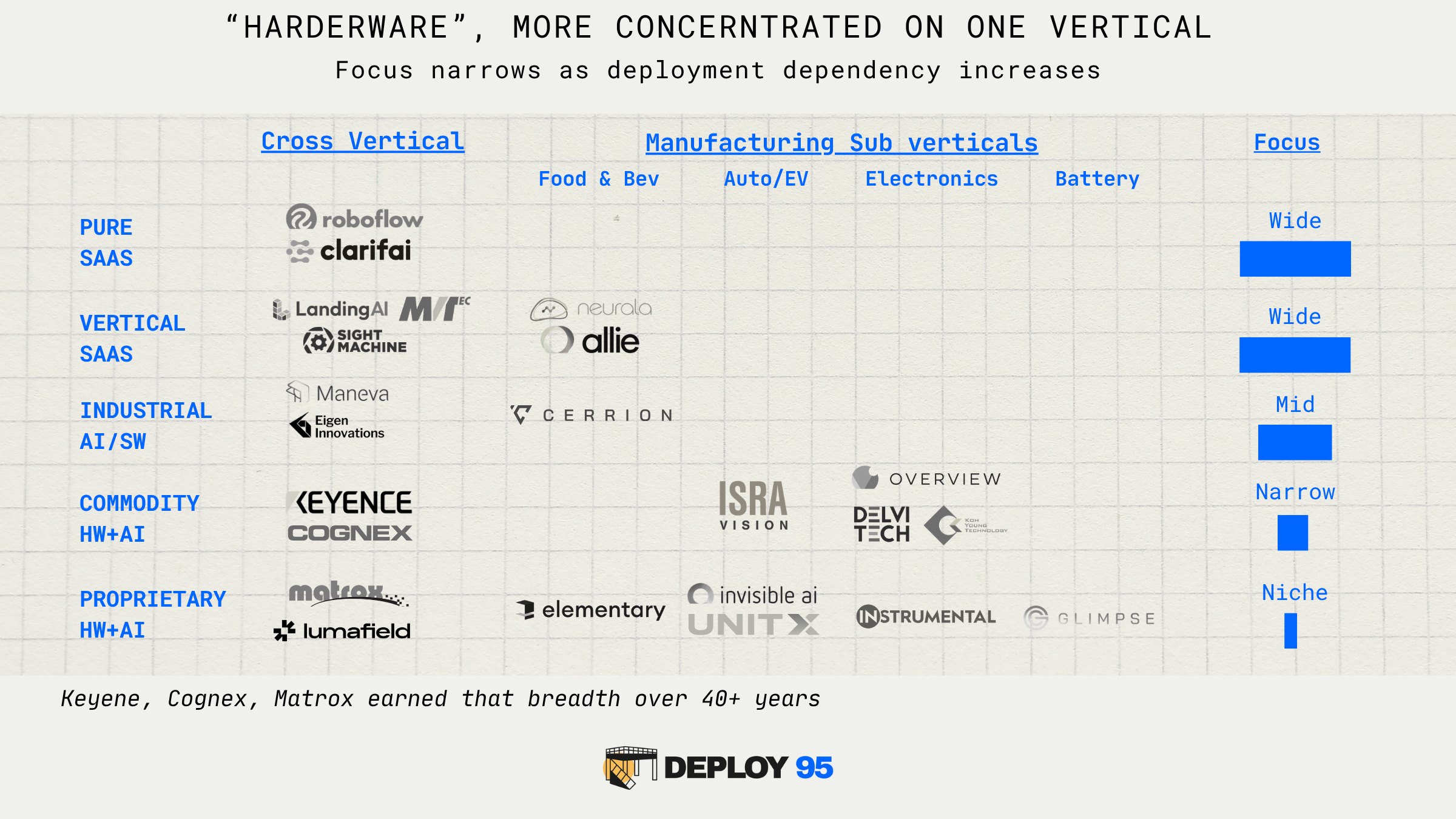
Instrumental concentrated on electronics PCBA inspection. Novarc focused on pipe welding. ANYbotics went deep in energy and mining inspection. Elementary built around electronics and semiconductor. None of them started broad and narrowed later. They picked one environment early and stayed in it.
Because feedback pulls your product direction
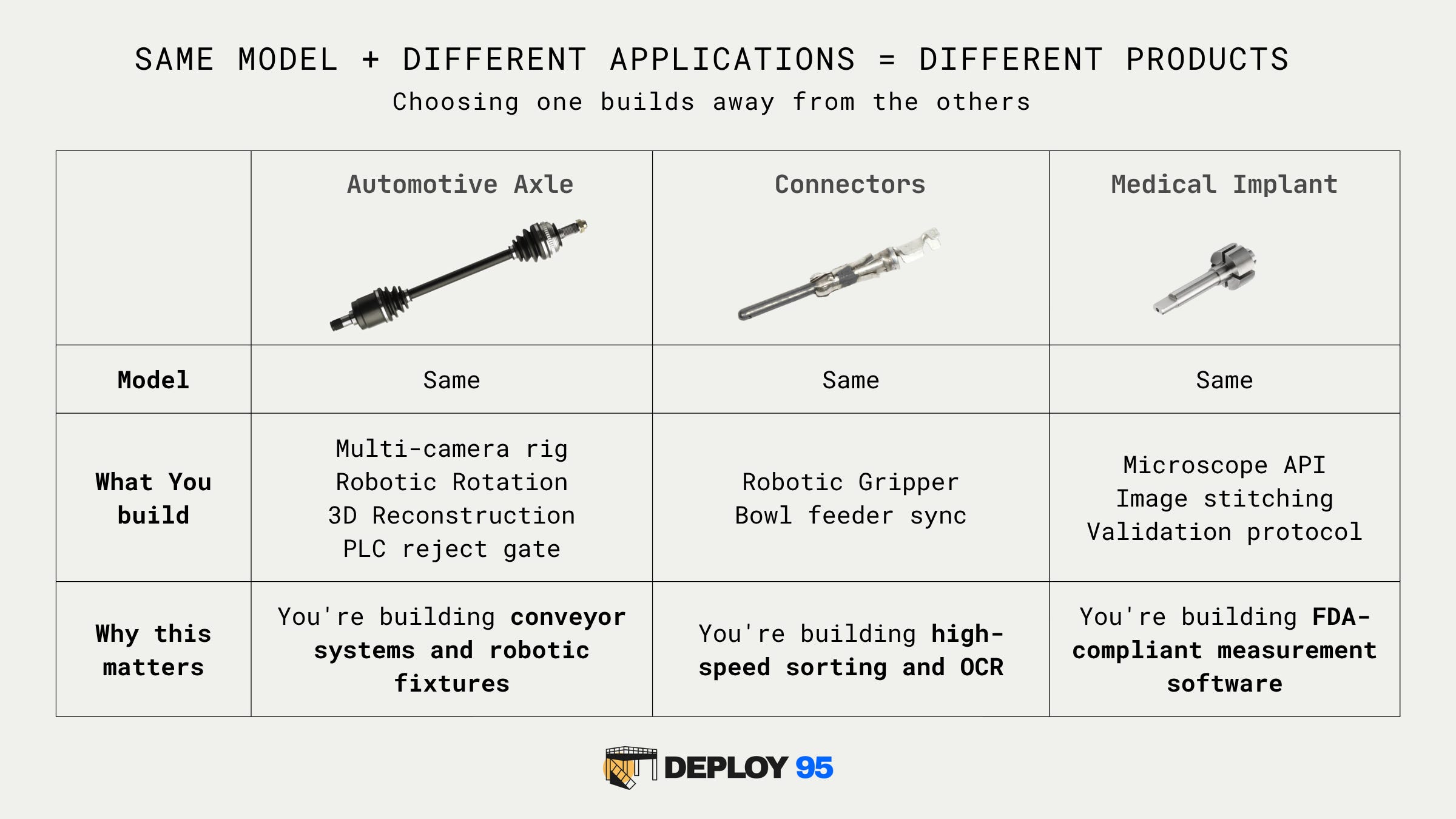
Consider a model that detects metal surface defects. On paper, it could apply to automotive axles, electronic connectors, and medical implants. The defects might even look similar. But the full product requirements are different at each site, because the factory setup, operational needs, and regulatory environment are different.
An automotive axle needs robotic part handling and PLC integration. A connector needs high-speed sorting at 2,000 parts per hour. A medical implant needs microscope-level resolution and FDA-compliant documentation. And a startup could not build all three products.
Even staying within automotive, you will face variation: different part sizes, different defect types, different cycle time requirements. But with prior deployment experience, it is much easier to build on what you already know. Over time, you develop the kind of domain expertise that becomes hard for competitors to replicate. Each similar deployment reinforces the last. Each dissimilar deployment pulls you in a new direction. Overtime, concentrating in one vertical reinforces your product strategy.
3: Application knowledge and Floor Access
If deployment is the proof and learning only compounds within one vertical, what are you actually building when you deploy, beyond the immediate revenue? Application knowledge. And at scale, it is worth more than the technology itself.
Matrox Imaging, a Montreal based vision company never venture-funded, was acquired by Zebra Technologies in 2022 at roughly 9x revenue. The technology was strong but not unique. What justified the price was 46 years of application knowledge: integrator relationships, deployment playbooks, failure mode libraries, and a deep understanding of what works where.
The big players build this knowledge on purpose. Cognex logged 80,000 customer visits in 2024. Keyence employs 8,300 field engineers who solve problems on-site. Every visit logs the use case, the constraints, and what broke. The next engineer entering a similar factory carries all of that context. Customer retention above 95% comes from the compounding value of a vendor who already understands their customer’s environment.
Where floor access comes from
If application knowledge is the asset, the next question is: how do you start building it?
Across the startups I studied, the first deployment came from access: a prior relationship that gave the founder a path onto a factory floor. Instrumental’s founders came from Apple’s factory floor. Overview and Glimpse were founded by ex-Tesla manufacturing leaders.
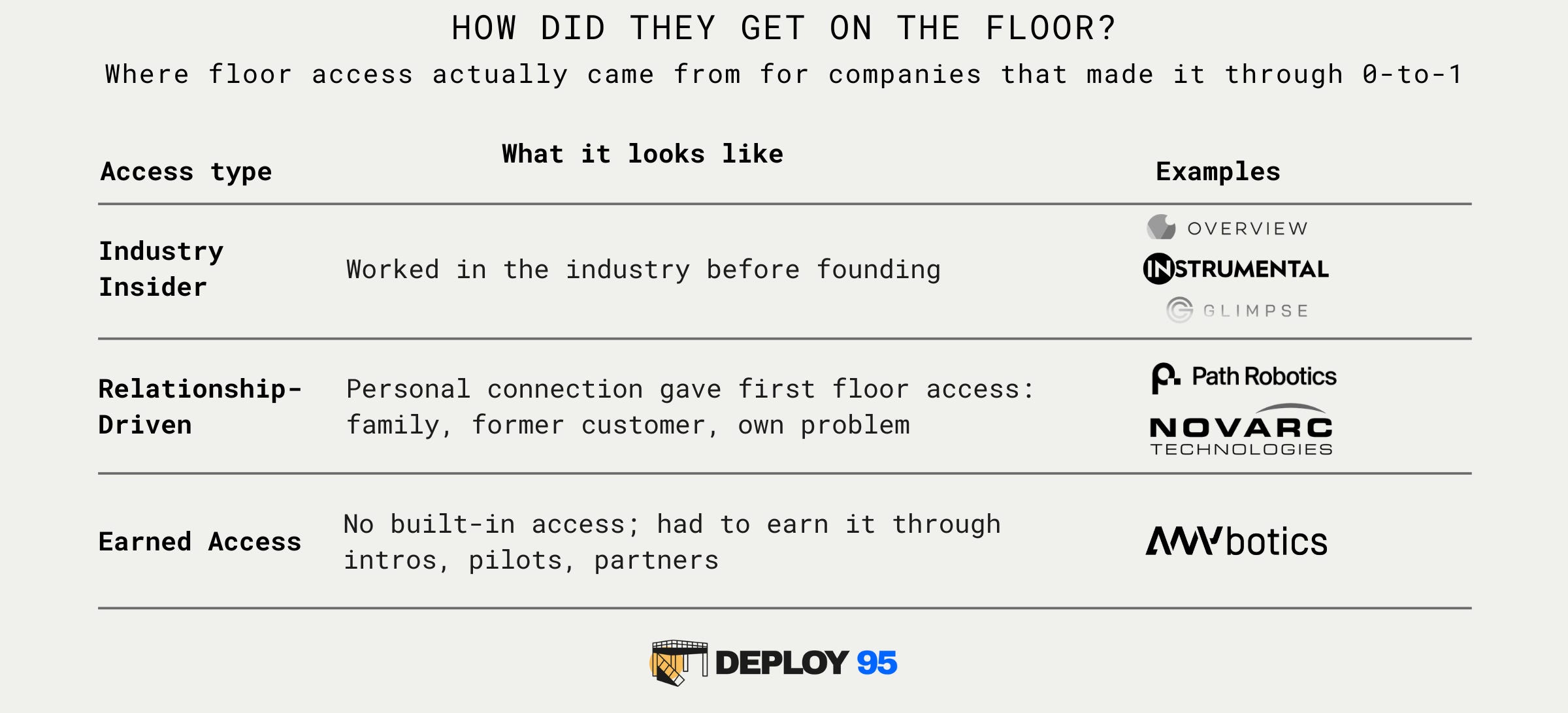
The companies that make it through 0-to-1 are the ones that got on a factory floor fastest. But whoever gives you access first also shapes your product in their direction. And your addressable market becomes a function of how many environments look like the one you just deployed in.
What if you do not have existing access? You are not out, but your GTM has an extra step. The next posts in this series cover how to earn your first deployment starting cold: through design partners, integrators, or a wedge use case that gets you on the floor.
Three Takeaways
1. GTM strategy should match where you sit on the stack. Pure software companies can run the PLG playbook because the product proves itself in a browser. The further you move toward integrated hardware, the more growth depends on deployment results rather than pipeline volume.
2. There is no shortcut past deployment. Across 40+ companies, I found no evidence that creative outbound, gifting, or clever messaging moved the needle for companies selling hardware-integrated systems. The unlock is always a deployment that proves transferability, it works much better than a better subject line.
3. The companies that scaled did three things early. They concentrated in one environment long enough to build transferable proof. They treated deployment knowledge as a compounding asset. And they got floor access early, let that first environment shape their product, then found similar customers.
There is a name for this pattern: deployment-led growth. Each successful deployment is your primary engine for winning the next customer. The primary driver for growth is deployments in similar enough environments that the knowledge transfers.
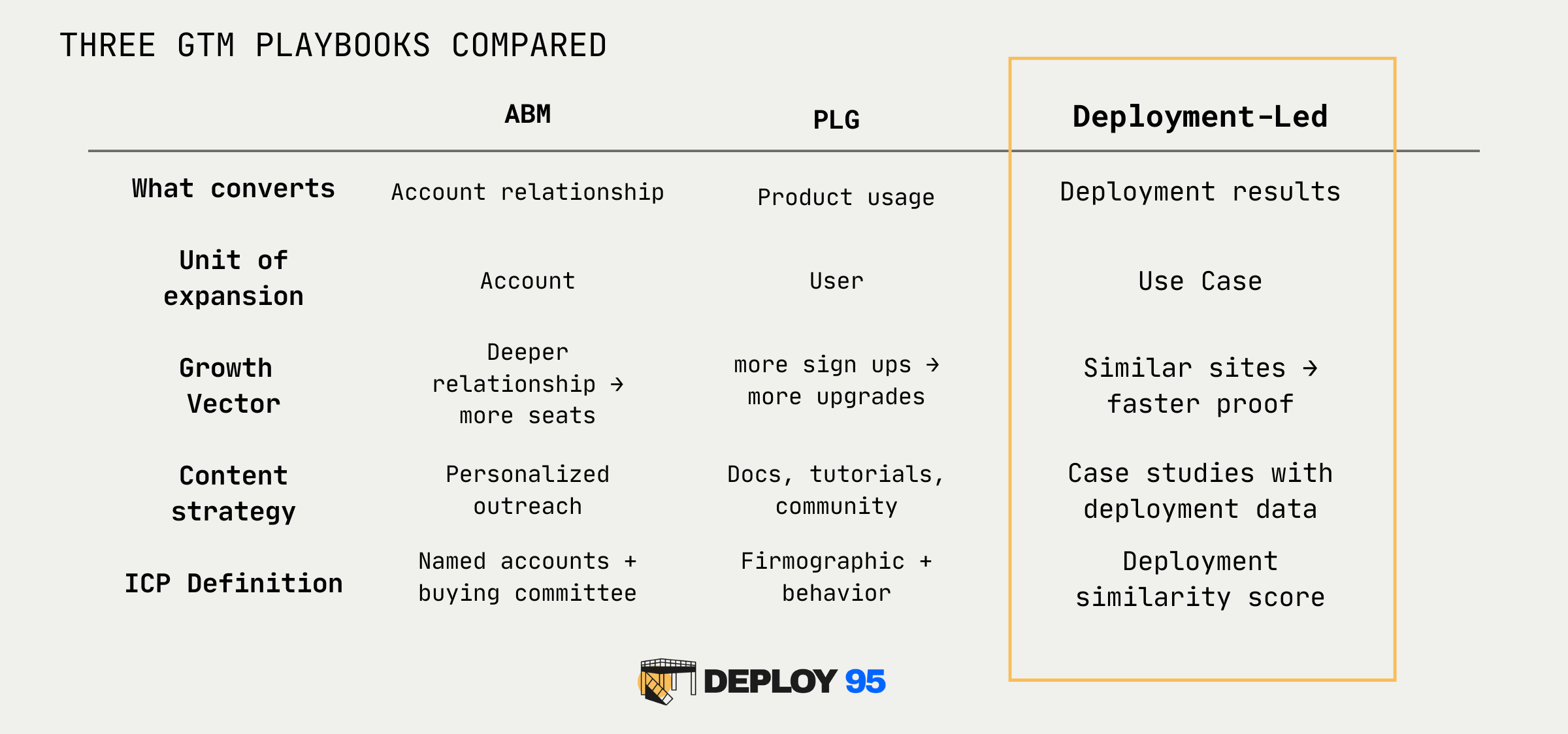
If deployment-led growth is the engine, why do most founders still build their GTM around pipeline volume and logo count? Part 2 covers the patterns that look like progress but actually slow you down.
About Deploy 95
Only 5% of industrial AI pilots convert to full deployment. This newsletter is about that gap: what happens between your model and the factory floor.
Hi! I’m Trista, grew up in manufacturing, built GTM at UnitX, now helping technical founders close the gap between traction and deployment. If you’re new, start with the POC Valley Series.
If you’re building in this space, investing in it, or stuck somewhere without a playbook, let’s connect on LinkedIn. I’d love to hear from you.
Glossary
PLG (Product-Led Growth): A go-to-market model where the product sells itself. Users try it, see the value, and buy. Common in software with free trials or freemium tiers.
ABM (Account-Based Marketing): A go-to-market model where you target specific companies with personalized outreach and tailored campaigns rather than casting a wide net.
The five tiers referenced in this analysis:
Pure SaaS Platform: Cloud-based computer vision tools for developers. Performance equals benchmark accuracy. No physical environment involved.
Vertical SaaS / ML Platform: Tooling for customers or integrators to build their own models. Customer handles deployment.
Industrial AI / Software: Deployed AI solution using off-the-shelf cameras. Performance depends heavily on the customer’s environment.
Commodity Hardware + AI: Standardized hardware and software bundle. The moat is application knowledge and installed base.
Proprietary Hardware + AI: Custom hardware tightly integrated with AI. Performance is inseparable from the physical system.